What Was the Difference Between American and European Conceptual Art?
Conceptual art, also referred to as conceptualism, is fine art in which the concept(s) or idea(s) involved in the piece of work take precedence over traditional artful, technical, and fabric concerns. Some works of conceptual fine art, sometimes called installations, may be constructed past anyone merely by post-obit a set of written instructions.[i] This method was fundamental to American artist Sol LeWitt's definition of conceptual fine art, one of the showtime to announced in print:
In conceptual fine art the idea or concept is the most of import attribute of the work. When an artist uses a conceptual class of art, it means that all of the planning and decisions are fabricated beforehand and the execution is a perfunctory thing. The idea becomes a motorcar that makes the art.[2]
Tony Godfrey, author of Conceptual Art (Art & Ideas) (1998), asserts that conceptual art questions the nature of art,[3] a notion that Joseph Kosuth elevated to a definition of art itself in his seminal, early on manifesto of conceptual fine art, Fine art after Philosophy (1969). The notion that art should examine its own nature was already a potent aspect of the influential art critic Cloudless Greenberg's vision of Modern art during the 1950s. With the emergence of an exclusively language-based art in the 1960s, however, conceptual artists such every bit Fine art & Linguistic communication, Joseph Kosuth (who became the American editor of Art-Language), and Lawrence Weiner began a far more radical interrogation of art than was previously possible (run into below). One of the get-go and most of import things they questioned was the mutual supposition that the role of the artist was to create special kinds of material objects.[iv] [five] [6]
Through its association with the Young British Artists and the Turner Prize during the 1990s, in popular usage, particularly in the United kingdom, "conceptual art" came to announce all contemporary art that does not practice the traditional skills of painting and sculpture.[7] 1 of the reasons why the term "conceptual art" has come to be associated with various contemporary practices far removed from its original aims and forms lies in the trouble of defining the term itself. As the artist Mel Bochner suggested as early on as 1970, in explaining why he does not like the epithet "conceptual", it is not always entirely clear what "concept" refers to, and it runs the risk of being confused with "intention". Thus, in describing or defining a work of art as conceptual information technology is important not to confuse what is referred to as "conceptual" with an creative person'south "intention".
Precursors [edit]
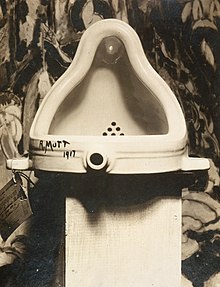

The French creative person Marcel Duchamp paved the way for the conceptualists, providing them with examples of prototypically conceptual works — the readymades, for instance. The almost famous of Duchamp'due south readymades was Fountain (1917), a standard urinal-basin signed by the artist with the pseudonym "R.Mutt", and submitted for inclusion in the annual, un-juried exhibition of the Society of Independent Artists in New York (which rejected it).[8] The artistic tradition does not see a commonplace object (such as a urinal) as art because it is not fabricated by an artist or with whatsoever intention of being art, nor is it unique or manus-crafted. Duchamp's relevance and theoretical importance for future "conceptualists" was later acknowledged by US artist Joseph Kosuth in his 1969 essay, Art after Philosophy, when he wrote: "All art (later on Duchamp) is conceptual (in nature) because art only exists conceptually".
In 1956 the founder of Lettrism, Isidore Isou, developed the notion of a piece of work of art which, by its very nature, could never be created in reality, but which could even so provide artful rewards by being contemplated intellectually. This concept, also called Art esthapériste (or "infinite-aesthetics"), derived from the infinitesimals of Gottfried Wilhelm Leibniz – quantities which could not really exist except conceptually. The electric current incarnation (As of 2013[update]) of the Isouian movement, Excoördism, self-defines equally the fine art of the infinitely large and the infinitely pocket-sized.
Origins [edit]
In 1961, philosopher and creative person Henry Flynt coined the term "concept art" in an article bearing the same name which appeared in the proto-Fluxus publication An Album of Chance Operations.[9] Flynt's concept art, he maintained, devolved from his notion of "cognitive nihilism", in which paradoxes in logic are shown to evacuate concepts of substance. Cartoon on the syntax of logic and mathematics, concept art was meant jointly to supersede mathematics and the formalistic music then current in serious art music circles.[x] Therefore, Flynt maintained, to merit the label concept art, a piece of work had to exist a critique of logic or mathematics in which a linguistic concept was the cloth, a quality which is absent from subsequent "conceptual fine art".[11]
The term assumed a unlike meaning when employed by Joseph Kosuth and by the English Art and Language grouping, who discarded the conventional fine art object in favour of a documented critical inquiry, that began in Art-Language: The Journal of Conceptual Fine art in 1969, into the artist'south social, philosophical, and psychological status. By the mid-1970s they had produced publications, indices, performances, texts and paintings to this end. In 1970 Conceptual Art and Conceptual Aspects, the showtime defended conceptual-art exhibition, took identify at the New York Cultural Center.[12]
The critique of formalism and of the commodification of art [edit]
Conceptual art emerged equally a movement during the 1960s – in part every bit a reaction against formalism equally then articulated by the influential New York art critic Cloudless Greenberg. According to Greenberg Modern fine art followed a process of progressive reduction and refinement toward the goal of defining the essential, formal nature of each medium. Those elements that ran counter to this nature were to be reduced. The task of painting, for example, was to define precisely what kind of object a painting truly is: what makes it a painting and cypher else. As it is of the nature of paintings to be flat objects with canvas surfaces onto which colored paint is applied, such things equally figuration, iii-D perspective illusion and references to external subject matter were all found to be inapplicable to the essence of painting, and ought to be removed.[xiii]
Some have argued that conceptual art connected this "dematerialization" of art by removing the need for objects birthday,[14] while others, including many of the artists themselves, saw conceptual art every bit a radical intermission with Greenberg's kind of formalist Modernism. Later artists continued to share a preference for fine art to exist self-disquisitional, besides as a distaste for illusion. Withal, by the end of the 1960s it was certainly clear that Greenberg'south stipulations for art to proceed inside the confines of each medium and to exclude external subject matter no longer held traction.[15] Conceptual fine art also reacted against the commodification of art; it attempted a subversion of the gallery or museum as the location and determiner of art, and the art market as the owner and distributor of art. Lawrence Weiner said: "In one case you know virtually a work of mine you ain it. There's no manner I can climb inside somebody'southward head and remove information technology." Many conceptual artists' work tin can therefore just be known nigh through documentation which is manifested by it, e.g., photographs, written texts or displayed objects, which some might argue are not in and of themselves the art. Information technology is sometimes (as in the piece of work of Robert Barry, Yoko Ono, and Weiner himself) reduced to a fix of written instructions describing a work, but stopping short of really making information technology—emphasising the idea as more important than the artifact. This reveals an explicit preference for the "art" side of the ostensible dichotomy between art and arts and crafts, where fine art, unlike craft, takes place within and engages historical soapbox: for example, Ono's "written instructions" make more sense alongside other conceptual art of the time.
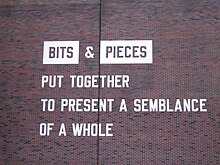
Lawrence Weiner. Bits & Pieces Put Together to Present a Semblance of a Whole, The Walker Art Middle, Minneapolis, 2005.
Language and/as art [edit]
Language was a key concern for the first moving ridge of conceptual artists of the 1960s and early 1970s. Although the utilisation of text in fine art was in no way novel, only in the 1960s did the artists Lawrence Weiner, Edward Ruscha,[16] Joseph Kosuth, Robert Barry, and Fine art & Linguistic communication begin to produce art past exclusively linguistic means. Where previously language was presented equally one kind of visual element alongside others, and subordinate to an overarching composition (east.thousand. Constructed Cubism), the conceptual artists used linguistic communication in place of castor and canvas, and allowed it to signify in its own right.[17] Of Lawrence Weiner's works Anne Rorimer writes, "The thematic content of individual works derives solely from the import of the linguistic communication employed, while presentational ways and contextual placement play crucial, all the same separate, roles."[xviii]
The British philosopher and theorist of conceptual fine art Peter Osborne suggests that amid the many factors that influenced the gravitation toward language-based art, a central office for conceptualism came from the turn to linguistic theories of significant in both Anglo-American analytic philosophy, and structuralist and post structuralist Continental philosophy during the centre of the twentieth century. This linguistic turn "reinforced and legitimized" the direction the conceptual artists took.[19] Osborne also notes that the early on conceptualists were the first generation of artists to complete degree-based academy preparation in art.[xx] Osborne later made the ascertainment that contemporary art is mail service-conceptual [21] in a public lecture delivered at the Fondazione Antonio Ratti, Villa Sucota in Como on July nine, 2010. It is a claim made at the level of the ontology of the work of art (rather than say at the descriptive level of mode or movement).
The American art historian Edward A. Shanken points to the example of Roy Ascott who "powerfully demonstrates the significant intersections between conceptual art and fine art-and-technology, exploding the conventional autonomy of these fine art-historical categories." Ascott, the British artist most closely associated with cybernetic art in England, was not included in Cybernetic Serendipity because his use of cybernetics was primarily conceptual and did non explicitly utilize technology. Conversely, although his essay on the application of cybernetics to art and art teaching, "The Construction of Change" (1964), was quoted on the dedication page (to Sol LeWitt) of Lucy R. Lippard's seminal Six Years: The Dematerialization of the Art Object from 1966 to 1972, Ascott'south anticipation of and contribution to the formation of conceptual fine art in Britain has received scant recognition, possibly (and ironically) because his piece of work was too closely allied with art-and-technology. Another vital intersection was explored in Ascott's use of the thesaurus in 1963 telematic connections:: timeline, which drew an explicit parallel between the taxonomic qualities of verbal and visual languages – a concept would be taken up in Joseph Kosuth's Second Investigation, Proposition i (1968) and Mel Ramsden's Elements of an Incomplete Map (1968).
Conceptual art and artistic skill [edit]
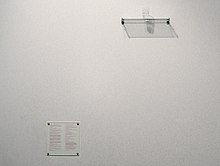
Past adopting language equally their exclusive medium, Weiner, Barry, Wilson, Kosuth and Art & Linguistic communication were able to sweep bated the vestiges of authorial presence manifested by formal invention and the handling of materials.[xviii]
An of import difference between conceptual art and more "traditional" forms of art-making goes to the question of artistic skill. Although skill in the handling of traditional media often plays little role in conceptual art, it is difficult to fence that no skill is required to make conceptual works, or that skill is e'er absent from them. John Baldessari, for instance, has presented realist pictures that he commissioned professional sign-writers to pigment; and many conceptual performance artists (eastward.1000. Stelarc, Marina Abramović) are technically accomplished performers and skilled manipulators of their own bodies. It is thus not so much an absence of skill or hostility toward tradition that defines conceptual art as an axiomatic condone for conventional, modern notions of authorial presence and of individual artistic expression.[ commendation needed ]
Contemporary influence [edit]
Proto-conceptualism has roots in the rise of Modernism with, for instance, Manet (1832–1883) and later Marcel Duchamp (1887–1968). The start moving ridge of the "conceptual art" motility extended from approximately 1967[22] to 1978. Early on "concept" artists like Henry Flynt (1940– ), Robert Morris (1931–2018), and Ray Johnson (1927–1995) influenced the later, widely accepted movement of conceptual art. Conceptual artists like Dan Graham, Hans Haacke, and Lawrence Weiner have proven very influential on subsequent artists, and well-known contemporary artists such as Mike Kelley or Tracey Emin are sometimes labeled[ by whom? ] "2d- or third-generation" conceptualists, or "post-conceptual" artists (the prefix Postal service- in art can frequently be interpreted every bit "considering of").
Contemporary artists have taken upwards many of the concerns of the conceptual art motility, while they may or may non term themselves "conceptual artists". Ideas such as anti-commodification, social and/or political critique, and ideas/information equally medium go along to be aspects of contemporary art, especially among artists working with installation art, functioning art, cyberspace.art and electronic/digital fine art.[23] [ need quotation to verify ]
Notable examples [edit]


- 1913 : Bicycle Wheel (Roue de bicyclette) by Marcel Duchamp. Assisted readymade. Bicycle cycle mounted by its fork on a painted wooden stool. The first readymade, fifty-fifty though he did non accept the idea for readymades until 2 years later. The original was lost. Besides, recognized every bit the first kinetic sculpture.[24]
- 1914 : Pharmacy (Pharmacie) by Marcel Duchamp. Rectified readymade. Gouache on chromolithograph of a scene with bare trees and a winding stream to which he added 2 circles, red and green.
- 1914 : Bottle Rack (also called Bottle Dryer or Hedgehog) (Egouttoir or Porte-bouteilles or Hérisson) past Marcel Duchamp. Readymade. A galvanized atomic number 26 bottle drying rack that Duchamp bought as an "already made" sculpture, just it gathered dust in the corner of his Paris studio. 2 years after in 1916, in correspondence from New York with his sister, Suzanne Duchamp in French republic, he expresses a want to make it a readymade. Suzanne, looking afterwards his Paris studio, has already disposed of information technology.
- 1915 : In Accelerate of the Broken Arm (En prévision du bras cassé) by Marcel Duchamp. Readymade. Snowfall shovel on which Duchamp advisedly painted its title. The outset piece the artist officially called a "readymade".
- 1915 : Pulled at 4 pins past Marcel Duchamp. Readymade. An unpainted chimney ventilator that turns in the air current. Duchamp liked that the literal translation meant cypher in English and had no relation to the object.
- 1916 : With Hidden Noise (A bruit secret) past Marcel Duchamp. Assisted readymade. A ball of twine between two contumely plates, joined past four screws. An unknown object has been placed in the brawl of twine by Duchamp'due south friend, Walter Arensberg.
- 1916 : Comb (Peigne) by Marcel Duchamp. Readymade. Steel domestic dog grooming comb inscribed along the edge.
- 1917 : Traveller'due south Folding Particular (...pliant,... de voyage) past Marcel Duchamp. Readymade. Underwood Typewriter cover.
- 1916–17 : Apolinère Enameled, 1916–1917. Rectified readymade. An altered Sapolin paint advertisement.
- 1917 : Fountain by Marcel Duchamp, described in an commodity in The Independent as the invention of conceptual art. It is also an early on example of an Institutional Critique[25]
- 1917 : 'Trap (Trébuchet) past Marcel Duchamp. Readymade. Wood and metal coatrack attached to floor.
- 1917 : Chapeau Rack (Porte-chapeaux), c. 1917, by Marcel Duchamp. Readymade. A wooden hatrack.[26]
- 1919 : Fifty.H.O.O.Q. by Marcel Duchamp. Rectified readymade. Pencil on a reproduction of Leonardo da Vinci'south Mona Lisa on which he drew a goatee and moustache titled with a fibroid pun.[27]
- 1919 : Unhappy readymade, by Marcel Duchamp. Assisted readymade. Duchamp instructed his sister Suzanne to hang a geometry textbook from the balcony of her Paris apartment. Suzanne carried out the instructions and painted a motion-picture show of the upshot.
- 1919 : l cc of Paris Air (50 cc air de Paris, Paris Air or Air de Paris) by Marcel Duchamp. Readymade. A glass ampoule containing air from Paris. Duchamp took the ampoule to New York Metropolis in 1920 and gave it to Walter Arensberg as a gift.
- 1920 : Fresh Widow by Marcel Duchamp. Readymade. An altered French window creating a pun.
- 1921 : Why Not Sneeze, Rose Sélavy? by Marcel Duchamp. Assisted readymade. Marble cubes in the shape of sugar lumps with a thermometer and cuttle bones in a small bird muzzle.
- 1921 : Belle Haleine, Eau de Voilette by Marcel Duchamp. Assisted readymade. An altered perfume bottle in the original box.[28]
- 1921 : The Brawl at Austerlitz by Marcel Duchamp. Readymade. Like Fresh Widow, fabricated by a carpenter co-ordinate to Duchamp's specifications.
- 1923 : Wanted, $2,000 Reward by Marcel Duchamp. Rectified readymade. Photographic collage on poster.
- 1952 : The premiere of American experimental composer John Cage's work, 4′33″, a 3-motility composition, performed by pianist David Tudor on August 29, 1952, in Bohemian Concert Hall, Woodstock, New York, as part of a recital of gimmicky piano music.[29] It is commonly perceived as "four minutes thirty-three seconds of silence".
- 1953 : Robert Rauschenberg produces Erased De Kooning Drawing, a drawing by Willem de Kooning which Rauschenberg erased. Information technology raised many questions about the cardinal nature of fine art, challenging the viewer to consider whether erasing another artist's piece of work could be a creative human action, as well as whether the work was only "art" because the famous Rauschenberg had done it.
- 1955 : Rhea Sue Sanders creates her first text pieces of the series pièces de complices, combining visual art with poetry and philosophy, and introducing the concept of complicity: the viewer must accomplish the fine art in her/his imagination.[30]
- 1956 : Isidore Isou introduces the concept of infinitesimal art in Introduction à une esthétique imaginaire (Introduction to Imaginary Aesthetics).
- 1957: Yves Klein, Aerostatic Sculpture (Paris), composed of 1001 blue balloons released into the sky from Galerie Iris Clert to promote his Proposition Monochrome; Blue Epoch exhibition. Klein also exhibited One Minute Fire Painting, which was a blue panel into which 16 firecrackers were set. For his adjacent major exhibition, The Void in 1958, Klein declared that his paintings were now invisible – and to prove it he exhibited an empty room.
- 1958: George Brecht invents the Event Score [31] which would become a central feature of Fluxus. Brecht, Dick Higgins, Allan Kaprow, Al Hansen, Jackson MacLow and others studied with John Cage between 1958 and 1959 at the New School leading direct to the creation of Happenings, Fluxus and Henry Flynt's concept art. Event Scores are elementary instructions to complete everyday tasks which tin can be performed publicly, privately, or non at all.
- 1958: Wolf Vostell Das Theater ist auf der Straße/The theater is on the street. The commencement Happening in Europe.[32]
- 1960: Yves Klein's action called A Bound Into The Void, in which he attempts to fly by leaping out of a window. He stated: "The painter has just to create one masterpiece, himself, constantly."
- 1960: The artist Stanley Brouwn declares that all the shoe shops in Amsterdam constitute an exhibition of his work.
- 1961: Wolf Vostell Cityrama, in Cologne – the first Happening in Germany.
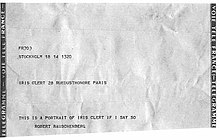
- 1961: Robert Rauschenberg sent a telegram to the Galerie Iris Clert which read: 'This is a portrait of Iris Clert if I say so.' as his contribution to an exhibition of portraits.
- 1961: Piero Manzoni exhibited Creative person's Shit, tins purportedly containing his own feces (although since the work would be destroyed if opened, no one has been able to say for certain). He put the tins on auction for their own weight in gilt. He likewise sold his own breath (enclosed in balloons) as Bodies of Air, and signed people's bodies, thus declaring them to be living works of art either for all time or for specified periods. (This depended on how much they are prepared to pay). Marcel Broodthaers and Primo Levi are amongst the designated "artworks".
- 1962: Creative person Barrie Bates rebrands himself every bit Billy Apple tree, erasing his original identity to keep his exploration of everyday life and commerce equally art. By this stage, many of his works are made by third parties.[33]
- 1962: Christo's Iron Curtain work. This consists of a barricade of oil barrels in a narrow Paris street which caused a large traffic jam. The artwork was non the barricade itself but the resulting traffic jam.
- 1962: Yves Klein presents Immaterial Pictorial Sensitivity in diverse ceremonies on the banks of the Seine. He offers to sell his ain "pictorial sensitivity" (whatever that was – he did not ascertain it) in commutation for gold leaf. In these ceremonies the purchaser gave Klein the gilded leaf in return for a certificate. Since Klein's sensitivity was immaterial, the purchaser was then required to burn the document whilst Klein threw one-half the gold leafage into the Seine. (At that place were seven purchasers.)
- 1962: Piero Manzoni created The Base of operations of the Globe, thereby exhibiting the entire planet equally his artwork.
- 1962: Alberto Greco began his Vivo Dito or Live Art series, which took place in Paris, Rome, Madrid, and Piedralaves. In each artwork, Greco called attention to the fine art in everyday life, thereby asserting that art was really a process of looking and seeing.
- 1962: FLUXUS Internationale Festspiele Neuester Musik in Wiesbaden with George Maciunas, Wolf Vostell, Nam June Paik and others.[34]
- 1963: George Brecht'south drove of Event-Scores, Water Yam, is published as the commencement Fluxkit past George Maciunas.
- 1963: Festum Fluxorum Fluxus in Düsseldorf with George Maciunas, Wolf Vostell, Joseph Beuys, Dick Higgins, Nam June Paik, Ben Patterson, Emmett Williams and others.
- 1963: Henry Flynt's article Concept Art is published in An Anthology of Take a chance Operations; a collection of artworks and concepts past artists and musicians that was published by Jackson Mac Low and La Monte Immature (ed.). An Anthology of Chance Operations documented the evolution of Dick Higgins'south vision of intermedia art in the context of the ideas of John Cage, and became an early on pre-Fluxus masterpiece. Flynt'due south "concept art" devolved from his idea of "cognitive nihilism" and from his insights most the vulnerabilities of logic and mathematics.
- 1964: Yoko Ono publishes Grapefruit: A Volume of Instructions and Drawings, an example of heuristic art, or a serial of instructions for how to obtain an aesthetic experience.
- 1965: Fine art & Language founder Michael Baldwin'south Mirror Piece. Instead of paintings, the work shows a variable number of mirrors that challenge both the company and Cloudless Greenberg's theory.[35]
- 1965: A circuitous conceptual fine art slice by John Latham called All the same and Chew. He invites fine art students to protest against the values of Clement Greenberg's Art and Culture, much praised and taught at Saint Martin'south School of Fine art in London, where Latham taught office-time. Pages of Greenberg's book (borrowed from the college library) are chewed by the students, dissolved in acrid and the resulting solution returned to the library bottled and labelled. Latham was then fired from his part-time position.
- 1965: with Show V, immaterial sculpture the Dutch artist Marinus Boezem introduced conceptual art in the netherlands. In the show, various air doors are placed where people can walk through them. People accept the sensory experience of warmth, air. Three invisible air doors, which arise as currents of common cold and warm are blown into the room, are indicated in the space with bundles of arrows and lines. The articulation of the space that arises is the result of invisible processes which influence the conduct of persons in that space, and who are included in the system as co-performers.
- Joseph Kosuth dates the concept of Ane and Three Chairs to the year 1965. The presentation of the work consists of a chair, its photograph, and an enlargement of a definition of the give-and-take "chair". Kosuth chose the definition from a dictionary. Iv versions with different definitions are known.
- 1966: Conceived in 1966 The Air Conditioning Show of Art & Language is published as an commodity in 1967 in the November event of Arts Mag.[36]
- 1966: Due north.E. Affair Co. Ltd. (Iain and Ingrid Baxter of Vancouver) showroom Bagged Place, the contents of a four-room flat wrapped in plastic numberless. The same year they registered equally a corporation and later organized their practice along corporate models, one of the offset international examples of the "aesthetic of administration".
- 1967: Mel Ramsden'southward get-go 100% Abstruse Paintings. The painting shows a listing of chemical components that constitutes the substance of the painting.[37]
- 1967: Sol LeWitt'due south Paragraphs on Conceptual Art were published by the American art journal Artforum. The Paragraphs marking the progression from Minimal to Conceptual Art.
- 1968: Michael Baldwin, Terry Atkinson, David Bainbridge and Harold Hurrell institute Art & Linguistic communication.[38]
- 1968: Lawrence Weiner relinquishes the physical making of his work and formulates his "Declaration of Intent", one of the almost important conceptual art statements following LeWitt's "Paragraphs on Conceptual Art". The declaration, which underscores his subsequent exercise, reads: "1. The artist may construct the piece. ii. The piece may be fabricated. 3. The slice need not exist built. Each being equal and consequent with the intent of the artist the decision as to condition rests with the receiver upon the occasion of receivership."
- Friedrich Heubach launches the mag Interfunktionen in Cologne, Germany, a publication that excelled in artists' projects. It originally showed a Fluxus influence, just afterwards moved toward conceptual art.
- 1969: The first generation of New York alternative exhibition spaces are established, including Billy Apple'south APPLE, Robert Newman's Gain Ground, where Vito Acconci produced many important early works, and 112 Greene Street.[33] [39]
- 1969: Robert Barry's Telepathic Piece at Simon Fraser University, Vancouver, of which he said "During the exhibition I volition try to communicate telepathically a work of art, the nature of which is a serial of thoughts that are non applicable to language or image."
- 1969: The first issue of Art-Language: The Periodical of conceptual art is published in May, edited by Terry Atkinson, David Bainbridge, Michael Baldwin and Harold Hurrell. Art & Language are the editors of this first number, and by the 2d number Joseph Kosuth joins and serves as American editor until 1972.
- 1969: Vito Acconci creates Following Piece, in which he follows randomly selected members of the public until they disappear into a individual space. The piece is presented as photographs.
- The English periodical Studio International publishes Joseph Kosuth´southward article "Fine art afterwards Philosophy" in three parts (October–Dec). It became the most discussed article on conceptual art.
- 1970: Ian Burn, Mel Ramsden and Charles Harrison bring together Fine art & Language.[38]
- 1970: Painter John Baldessari exhibits a film in which he sets a serial of erudite statements by Sol LeWitt on the subject field of conceptual fine art to popular tunes like "Camptown Races" and "Some Enchanted Evening".
- 1970: Douglas Huebler exhibits a series of photographs taken every two minutes while driving along a road for 24 minutes.
- 1970: Douglas Huebler asks museum visitors to write downwards 'i authentic surreptitious'. The resulting 1800 documents are compiled into a book which, by some accounts, makes for very repetitive reading equally most secrets are similar.
- 1971: Hans Haacke's Existent Time Social System. This piece of systems art detailed the real estate holdings of the third largest landowners in New York City. The properties, mostly in Harlem and the Lower East Side, were decrepit and poorly maintained, and represented the largest concentration of existent estate in those areas under the control of a single group. The captions gave various financial details about the buildings, including contempo sales between companies endemic or controlled by the same family unit. The Guggenheim museum cancelled the exhibition, stating that the overt political implications of the work constituted "an conflicting substance that had entered the art museum organism". There is no show to suggest that the trustees of the Guggenheim were linked financially to the family which was the subject of the work.
- 1972: The Art & Linguistic communication Institute exhibits Index 01 at the Documenta 5, an installation indexing text-works by Art & Language and text-works from Art-Language.
- 1972: Antonio Caro exhibits in the National Fine art Salon (Museo Nacional, Bogotá, Colombia) his work: Aquinocabeelarte (Art does non fit here), where each of the letters is a dissever poster, and nether each letter is written the name of some victim of state repression.
- 1972: Fred Forest buys an area of bare space in the newspaper Le Monde and invites readers to fill up information technology with their own works of art.
- General Idea launch File magazine in Toronto. The magazine functioned as something of an extended, collaborative artwork.
- 1973: Jacek Tylicki lays out blank canvases or newspaper sheets in the natural environment for nature to create art.
- 1974: Cadillac Ranch most Amarillo, Texas.
- 1975–76: Three problems of the journal The Flim-flam were published by Art & Linguistic communication in New York. The editor was Joseph Kosuth. The Fob became an important platform for the American members of Art & Linguistic communication. Karl Beveridge, Ian Burn down, Sarah Charlesworth, Michael Corris, Joseph Kosuth, Andrew Menard, Mel Ramsden and Terry Smith wrote articles which thematized the context of contemporary art. These manufactures exemplify the evolution of an institutional critique within the inner circle of conceptual art. The criticism of the art world integrates social, political and economical reasons.
- 1975–77 Orshi Drozdik's Individual Mythology operation, photography and offsetprint serial and her theory of ImageBank in Budapest.
- 1976: facing internal problems, members of Art & Language divide. The destiny of the proper noun Art & Linguistic communication remains in Michael Baldwin, Mel Ramsden and Charles Harrison hands.
- 1977: Walter De Maria'southward Vertical World Kilometer in Kassel, Germany. This was a ane kilometer brass rod which was sunk into the world so that nothing remained visible except a few centimeters. Despite its size, therefore, this piece of work exists mostly in the viewer's listen.
- 1982: The opera Victorine past Fine art & Language was to be performed in the city of Kassel for documenta 7 and shown alongside Fine art & Language Studio at 3 Wesley Place Painted by Actors, simply the functioning was cancelled.[40]
- 1986: Fine art & Language are nominated for the Turner Prize.
- 1989: Christopher Williams' Angola to Vietnam is first exhibited. The work consists of a series of black-and-white photographs of drinking glass botanical specimens from the Botanical Museum at Harvard University, chosen according to a listing of the 30-six countries in which political disappearances were known to accept taken place during the year 1985.
- 1990: Ashley Bickerton and Ronald Jones included in "Mind Over Matter: Concept and Object" exhibition of "third generation Conceptual artists" at the Whitney Museum of American Fine art.[41]
- 1991: Ronald Jones exhibits objects and text, art, history and scientific discipline rooted in grim political reality at Metro Pictures Gallery.[42]
- 1991: Charles Saatchi funds Damien Hirst and the next year in the Saatchi Gallery exhibits his The Physical Impossibility of Death in the Mind of Someone Living, a shark in formaldehyde in a vitrine.
- 1992: Maurizio Bolognini starts to "seal" his Programmed Machines: hundreds of computers are programmed and left to run ad infinitum to generate inexhaustible flows of random images which nobody would meet.[43]
- 1993: Matthieu Laurette established his artistic birth certificate past taking part in a French TV game called Tournez manège (The Dating Game) where the female presenter asked him who he was, to which he replied: 'A multimedia artist'. Laurette had sent out invitations to an art audience to view the prove on TV from their homes, turning his staging of the artist into a performed reality.
- 1993: Vanessa Beecroft holds her first performance in Milan, Italian republic, using models to act as a 2d audition to the brandish of her diary of food.
- 1999: Tracey Emin is nominated for the Turner Prize. Part of her exhibit is My Bed, her dishevelled bed, surrounded by detritus such every bit condoms, blood-stained knickers, bottles and her sleeping accommodation slippers.
- 2001: Martin Creed wins the Turner Prize for Piece of work No. 227: The lights going on and off, an empty room in which the lights become on and off.[44]
- 2003: damali ayo exhibits at the Eye of Gimmicky Art, Seattle, WA Flesh Tone #one: Skinned, a collaborative self-portrait where she asked paint mixers from local hardware stores to create house pigment to lucifer various parts of her trunk, while recording the interactions.[45]
- 2004: Andrea Fraser's video Untitled, a certificate of her sexual encounter in a hotel room with a collector (the collector having agreed to help finance the technical costs for enacting and filming the encounter) is exhibited at the Friedrich Petzel Gallery. Information technology is accompanied by her 1993 work Don't Postpone Joy, or Collecting Can Exist Fun, a 27-page transcript of an interview with a collector in which the majority of the text has been deleted.
- 2005: Simon Starling wins the Turner Prize for Shedboatshed, a wooden shed which he had turned into a gunkhole, floated downwards the Rhine and turned back into a shed again.[46]
- 2005: Maurizio Nannucci creates the big neon installation All Fine art Has Been Contemporary on the facade of Altes Museum in Berlin.
- 2014: Olaf Nicolai creates the Memorial for the Victims of Nazi Military Justice on Vienna's Ballhausplatz afterwards winning an international contest. The inscription on top of the three-step sculpture features a poem past Scottish poet Ian Hamilton Finlay (1924–2006) with just 2 words: all lonely.
Notable conceptual artists [edit]
- Kevin Abosch (built-in 1969)
- Vito Acconci (1940–2017)
- Bas Jan Ader (1942–1975)
- Vikky Alexander (born 1959)
- Francis Alÿs (born 1959)
- Keith Arnatt (1930–2008)
- Fine art & Language
- Roy Ascott (born 1934)
- Marina Abramović (built-in 1946)
- Billy Apple (born 1935)
- Shusaku Arakawa (1936–2010)
- Christopher D'Arcangelo (1955–1979)
- Michael Asher (1943–2012)
- Mireille Astore (born 1961)
- damali ayo (born 1972)
- Abel Azcona (born 1988)
- John Baldessari (1931–2020)
- Adina Bar-On (built-in 1951)
- NatHalie Braun Barends
- Artur Barrio (born 1945)
- Robert Barry (born 1936)
- Lothar Baumgarten (1944–2018)
- Joseph Beuys (1921–1986)
- Adolf Bierbrauer (1915–2012)
- Mark Bloch (born 1956)
- Mel Bochner (built-in 1940)
- Marinus Boezem (born 1934)
- Maurizio Bolognini (born 1952)
- Allan Bridge (1945–1995)
- Marcel Broodthaers (1924–1976)
- Chris Brunt (1946–2015)
- María Teresa Burga Ruiz (1935–2021)
- Daniel Buren (born 1938)
- Victor Burgin (born 1941)
- Donald Burgy (born 1937)
- Maris Bustamante (built-in 1949)
- John Cage (1912–1992)
- Cai Guo-Qiang (born 1957)
- Sophie Calle (born 1953)
- Graciela Carnevale (built-in 1942)
- Roberto Chabet (1937–2013)
- Greg Colson (born 1956)
- Martin Creed (born 1968)
- Cory Danziger (born 1977)
- Jack Daws (built-in 1970)
- Jeremy Deller (built-in 1966)
- Agnes Denes (built-in 1938)
- Jan Dibbets (born 1941)
- Mark Divo (born 1966)
- Brad Downey (born 1980)
- Marcel Duchamp (1887–1968)
- Olafur Eliasson (born 1967)
- Noemí Escandell (1942–2019)
- Ken Feingold (born 1952)
- Teresita Fernández (born 1968)
- Fluxus
- Henry Flynt (born 1940)
- Andrea Fraser (built-in 1965)
- Jens Galschiøt (built-in 1954)
- Kendell Geers
- Thierry Geoffroy (born 1961)
- Jochen Gerz (born 1940)
- Gilbert and George Gilbert (born 1943) George (built-in 1942)
- Manav Gupta (born 1967)
- Felix Gonzalez-Torres (1957–1996)
- Allan Graham (1943–2019)
- Dan Graham (1942-2022)
- Hans Haacke (born 1936)
- Iris Häussler (born 1962)
- Irma Hünerfauth (1907–1998)
- Oliver Herring (born 1964)
- Andreas Heusser (born 1976)
- Jenny Holzer (built-in 1950)
- Greer Honeywill (born 1945)
- Zhang Huan (born 1965)
- Douglas Huebler (1924–1997)
- General Thought
- David Ireland (1930–2009)
- Alfredo Jaar (born 1956)
- Ray Johnson (1927–1995)
- Ronald Jones (1952–2019)
- Ilya Kabakov (born 1933)
- On Kawara (1932–2014)
- Jonathon Keats (born 1971)
- Mary Kelly (built-in 1941)
- Yves Klein (1928–1962)
- John Knight (artist) (built-in 1945)
- Joseph Kosuth (born 1945)
- Barbara Kruger (born 1945)
- Yayoi Kusama (born 1929)
- Magali Lara (born 1956)
- John Latham (1921–2006)
- Matthieu Laurette (born 1970)
- Sol LeWitt (1928–2007)
- Annette Lemieux (born 1957)
- Elliott Linwood (born 1956)
- Noah Lyon (born 1979)
- Richard Long (born 1945)
- Mark Lombardi (1951–2000)
- George Maciunas (1931–1978)
- Teresa Margolles (born 1963)
- María Evelia Marmolejo (born 1958)
- Piero Manzoni (1933–1963)
- Tom Marioni (born 1937)
- Phyllis Marking (1921–2004)
- Danny Matthys (born 1947)
- Allan McCollum (born 1944)
- Cildo Meireles (born 1948)
- Ana Mendieta (built-in 1985)
- Marta Minujín (born 1943)
- Linda Montano (born 1942)
- Robert Morris (artist) (1931–2018)
- N.E. Thing Co. Ltd. (Iain & Ingrid Baxter) Iain (born 1936) Ingrid (born 1938)
- Maurizio Nannucci (born 1939)
- Bruce Nauman (born 1941)
- Olaf Nicolai (born 1962)
- Margaret Noble (born 1972)
- Yoko Ono (born 1933)
- Roman Opałka (1931–2011)
- Dennis Oppenheim (1938–2011)
- Michele Pred
- Adrian Piper (built-in 1948)
- William Pope.L (born 1955)
- Liliana Porter (born 1941)
- Dmitri Prigov (1940–2007)
- Guillem Ramos-Poquí (built-in 1944)
- Charles Recher (1950–2017)
- Jim Ricks (born 1973)
- Lotty Rosenfeld (1943–2020)
- Martha Rosler (built-in 1943)
- Allen Ruppersberg (born 1944)
- Santiago Sierra (born 1966)
- Bodo Sperling (born 1952)
- Stelarc (born 1946)
- One thousand. Vänçi Stirnemann (born 1951)
- Hiroshi Sugimoto (born 1948)
- Stephanie Syjuco (born 1974)
- Hakan Topal (born 1972)
- Endre Tot (born 1937)
- David Tremlett (born 1945)
- Tucumán arde (1968)
- Jacek Tylicki (born 1951)
- Mierle Laderman Ukeles (built-in 1939)
- Wolf Vostell (1932–1998)
- Mark Wallinger (born 1959)
- Gillian Wearing (born 1963)
- Peter Weibel (born 1945)
- Lawrence Weiner (born 1942)
- Roger Welch (born 1946)
- Christopher Williams (born 1956)
- xurban commonage
- Industry of the Ordinary
- Arne Quinze (built-in 1971)
Encounter also [edit]
- Mail service-conceptualism
- Anti-fine art
- Anti-anti-fine art
- Body art
- Classificatory disputes about art
- Conceptual compages
- Contemporary art
- Danger music
- Experiments in Art and Technology
- Found object
- Gutai group
- Happening
- Fluxus
- Information art
- Installation art
- Intermedia
- Land art
- Modern art
- Moscow Conceptualists
- Neo-conceptual fine art
- Olfactory fine art
- Net art
- Postmodern art
- Relational art
- Generative Art
- Street installation
- Something Else Press
- Systems fine art
- Video fine art
- Visual arts
- Fine art/MEDIA
Private works [edit]
- Fountain
- One and Three Chairs
- The Bride Stripped Blank Past Her Bachelors, Even
- Mirror Piece
- Clandestine Painting
- Victorine
References [edit]
- ^ "Wall Drawing 811 – Sol LeWitt". Archived from the original on ii March 2007.
- ^ Sol LeWitt "Paragraphs on Conceptual Art", Artforum, June 1967.
- ^ Godrey, Tony (1988). Conceptual Art (Art & Ideas). London: Phaidon Printing Ltd. ISBN978-0-7148-3388-0.
- ^ Joseph Kosuth, Art After Philosophy (1969). Reprinted in Peter Osborne, Conceptual Art: Themes and Movements, Phaidon, London, 2002. p. 232
- ^ Art & Linguistic communication, Fine art-Language The Journal of conceptual fine art: Introduction (1969). Reprinted in Osborne (2002) p. 230
- ^ Ian Fire, Mel Ramsden: "Notes On Assay" (1970). Reprinted in Osborne (2003), p. 237. Eastward.grand. "The outcome of much of the 'conceptual' piece of work of the past 2 years has been to carefully clear the air of objects."
- ^ "Turner Prize history: Conceptual art". Tate Gallery. tate.org.united kingdom. Accessed August 8, 2006
- ^ Tony Godfrey, Conceptual Fine art, London: 1998. p. 28
- ^ "Essay: Concept Art". world wide web.henryflynt.org.
- ^ "The Crystallization of Concept Art in 1961". www.henryflynt.org.
- ^ Henry Flynt, "Concept-Art (1962)", Translated and introduced past Nicolas Feuillie, Les presses du réel, Avant-gardes, Dijon.
- ^ "Conceptual Art (Conceptualism) – Artlex". Archived from the original on May xvi, 2013.
- ^ Rorimer, p. 11
- ^ Lucy Lippard & John Chandler, "The Dematerialization of Art", Fine art International 12:2, February 1968. Reprinted in Osborne (2002), p. 218
- ^ Rorimer, p. 12
- ^ "Ed Ruscha and Photography". The Fine art Institute of Chicago. i March – one June 2008. Archived from the original on 31 May 2010. Retrieved 14 September 2010.
- ^ Anne Rorimer, New Art in the Sixties and Seventies, Thames & Hudson, 2001; p. 71
- ^ a b Rorimer, p. 76
- ^ Peter Osborne, Conceptual Art: Themes and movements, Phaidon, London, 2002. p. 28
- ^ Osborne (2002), p. 28
- ^ http://www.fondazioneratti.org/mat/mostre/Contemporary%20art%20is%20post-conceptual%20art%twenty/Leggi%20il%20testo%20della%20conferenza%20di%20Peter%20Osborne%20in%20PDF.pdf [ dead link ]
- ^ Conceptual Art – "In 1967, Sol LeWitt published Paragraphs on Conceptual Fine art (considered by many to be the motility'southward manifesto) [...]."
- ^ "Conceptual Art – The Art Story". theartstory.org. The Art Story Foundation. Retrieved 25 September 2014.
- ^ Atkins, Robert: Artspeak, 1990, Abbeville Printing, ISBN 1-55859-010-2
- ^ Hensher, Philip (2008-02-20). "The loo that shook the world: Duchamp, Man Ray, Picabi". London: The Independent (Extra). pp. ii–5.
- ^ Judovitz: Unpacking Duchamp, 92–94.
- ^ [1] Marcel Duchamp.cyberspace, retrieved December 9, 2009
- ^ Marcel Duchamp, Belle haleine – Eau de voilette, Collection Yves Saint Laurent et Pierre Bergé, Christie'due south Paris, Lot 37. 23 – 25 Feb 2009
- ^ Kostelanetz, Richard (2003). Conversing with John Cage. New York: Routledge. ISBN 0-415-93792-2. pp. 69–71, 86, 105, 198, 218, 231.
- ^ Bénédicte Demelas: Des mythes et des réalitées de l'avant-garde française. Presses universitaires de Rennes, 1988
- ^ Kristine Stiles & Peter Selz, Theories and Documents of Contemporary Art: A Sourcebook of Artists' Writings (Second Edition, Revised and Expanded by Kristine Stiles) University of California Printing 2012, p. 333
- ^ ChewingTheSun. "Vorschau – Museum Morsbroich".
- ^ a b Byrt, Anthony. "Brand, new". Frieze Magazine . Retrieved 28 Nov 2012.
- ^ Fluxus at 50. Stefan Fricke, Alexander Klar, Sarah Maske, Kerber Verlag, 2012, ISBN 978-iii-86678-700-1.
- ^ Tate (2016-04-22), Art & Language – Conceptual Art, Mirrors and Selfies | TateShots , retrieved 2017-07-29
- ^ "Air-conditioning Prove / Air Testify / Frameworks 1966–67". www.macba.cat. Archived from the original on 2017-07-29. Retrieved 2017-07-29 .
- ^ "ART & LANGUAGE UNCOMPLETED". www.macba.cat . Retrieved 2017-07-29 .
- ^ a b "BBC – Coventry and Warwickshire Culture – Art and Linguistic communication". www.bbc.co.great britain . Retrieved 2017-07-29 .
- ^ Terroni, Christelle (7 October 2011). "The Rise and Fall of Alternative Spaces". Books&ideas.internet . Retrieved 28 November 2012.
- ^ Harrison, Charles (2001). Conceptual art and painting Further essays on Art & Linguistic communication. Cambridge: The MIT Press. p. 58. ISBN0-262-58240-6.
- ^ Brenson, Michael (19 October 1990). "Review/Art; In the Arena of the Mind, at the Whitney". The New York Times.
- ^ Smith, Roberta. "Fine art in review: Ronald Jones Metro Pictures", The New York Times, 27 December 1991. Retrieved eight July 2008.
- ^ Sandra Solimano, ed. (2005). Maurizio Bolognini. Programmed Machines 1990–2005. Genoa: Villa Croce Museum of Gimmicky Fine art, Neos. ISBN88-87262-47-0.
- ^ "BBC News – ARTS – Creed lights upwardly Turner prize". 10 Dec 2001.
- ^ "Third Coast Audio Festival Behind the Scenes with damali ayo".
- ^ "The Times & The Sun Times". www.thetimes.co.united kingdom of great britain and northern ireland.
Further reading [edit]
- Books
- Charles Harrison, Essays on Fine art & Linguistic communication, MIT Printing, 1991
- Charles Harrison, Conceptual Art and Painting: Further essays on Art & Linguistic communication, MIT press, 2001
- Ermanno Migliorini, Conceptual Fine art, Florence: 1971
- Klaus Honnef, Concept Art, Cologne: Phaidon, 1972
- Ursula Meyer, ed., Conceptual Art, New York: Dutton, 1972
- Lucy R. Lippard, Half dozen Years: the Dematerialization of the Art Object From 1966 to 1972. 1973. Berkeley: University of California Printing, 1997.
- Gregory Battcock, ed., Thought Art: A Critical Anthology, New York: E. P. Dutton, 1973
- Jürgen Schilling, Aktionskunst. Identität von Kunst und Leben? Verlag C.J. Bucher, 1978, ISBN three-7658-0266-2.
- Juan Vicente Aliaga & José Miguel G. Cortés, ed., Arte Conceptual Revisado/Conceptual Art Revisited, Valencia: Universidad Politécnica de Valencia, 1990
- Thomas Dreher, Konzeptuelle Kunst in Amerika und England zwischen 1963 und 1976 (Thesis Ludwig-Maximilians-Universität, München), Frankfurt am Principal: Peter Lang, 1992
- Robert C. Morgan, Conceptual Art: An American Perspective, Jefferson, NC/London: McFarland, 1994
- Robert C. Morgan, Art into Ideas: Essays on Conceptual Fine art, Cambridge et al.: Cambridge University Printing, 1996
- Charles Harrison and Paul Wood, Art in Theory: 1900–1990, Blackwell Publishing, 1993
- Tony Godfrey, Conceptual Fine art, London: 1998
- Alexander Alberro & Blake Stimson, ed., Conceptual Fine art: A Critical Anthology, Cambridge, Massachusetts, London: MIT Press, 1999
- Michael Newman & Jon Bird, ed., Rewriting Conceptual Fine art, London: Reaktion, 1999
- Anne Rorimer, New Art in the 60s and 70s: Redefining Reality, London: Thames & Hudson, 2001
- Peter Osborne, Conceptual Art (Themes and Movements), Phaidon, 2002 (See also the external links for Robert Smithson)
- Alexander Alberro. Conceptual art and the politics of publicity. MIT Press, 2003.
- Michael Corris, ed., Conceptual Fine art: Theory, Do, Myth, Cambridge, England: Cambridge University Press, 2004
- Daniel Marzona, Conceptual Art, Cologne: Taschen, 2005
- John Roberts, The Intangibilities of Course: Skill and Deskilling in Art Afterward the Readymade, London and New York: Verso Books, 2007
- Peter Goldie and Elisabeth Schellekens, Who's afraid of conceptual art?, Abingdon [etc.] : Routledge, 2010. – VIII, 152 p. : sick. ; twenty cm ISBN 0-415-42281-7 hbk : ISBN 978-0-415-42281-9 hbk : ISBN 0-415-42282-v pbk : ISBN 978-0-415-42282-six pbk
- Essays
- Andrea Sauchelli, 'The Acquaintance Principle, Aesthetic Judgments, and Conceptual Art, Periodical of Aesthetic Education (forthcoming, 2016).
- Exhibition catalogues
- Diagram-boxes and Counterpart Structures, exh.cat. London: Molton Gallery, 1963.
- January 5–31, 1969, exh.cat., New York: Seth Siegelaub, 1969
- When Attitudes Get Course, exh.cat., Bern: Kunsthalle Bern, 1969
- 557,087, exh.cat., Seattle: Seattle Art Museum, 1969
- Konzeption/Formulation, exh.cat., Leverkusen: Städt. Museum Leverkusen et al., 1969
- Conceptual Art and Conceptual Aspects, exh.cat., New York: New York Cultural Middle, 1970
- Fine art in the Heed, exh.true cat., Oberlin, Ohio: Allen Memorial Fine art Museum, 1970
- Information, exh.cat., New York: Museum of Modern Fine art, 1970
- Software, exh.cat., New York: Jewish Museum, 1970
- State of affairs Concepts, exh.true cat., Innsbruck: Forum für aktuelle Kunst, 1971
- Fine art conceptuel I, exh.cat., Bordeaux: capcMusée d'art contemporain de Bordeaux, 1988
- L'fine art conceptuel, exh.cat., Paris: ARC–Musée d'Art Moderne de la Ville de Paris, 1989
- Christian Schlatter, ed., Art Conceptuel Formes Conceptuelles/Conceptual Art Conceptual Forms, exh.cat., Paris: Galerie 1900–2000 and Galerie de Poche, 1990
- Reconsidering the Object of Art: 1965–1975, exh.true cat., Los Angeles: Museum of Gimmicky Art, 1995
- Global Conceptualism: Points of Origin, 1950s–1980s, exh.true cat., New York: Queens Museum of Fine art, 1999
- Open up Systems: Rethinking Art c. 1970, exh.cat., London: Tate Modern, 2005
- Fine art & Language Uncompleted: The Philippe Méaille Collection, MACBA Press, 2014
- Light Years: Conceptual Fine art and the Photograph 1964–1977, exh.cat., Chicago: Art Institute of Chicago, 2011
External links [edit]
Source: https://en.wikipedia.org/wiki/Conceptual_art
Belum ada Komentar untuk "What Was the Difference Between American and European Conceptual Art?"
Posting Komentar