How Does the Eve of St Agnes Go Again Enlightenment Era

The Eve of St. Agnes is a Romantic narrative verse form of 42 Spenserian stanzas set in the Middle Ages. It was written by John Keats in 1819 and published in 1820. The poem was considered by many of Keats's contemporaries and the succeeding Victorians to be i of his finest and was influential in 19th-century literature.[ane]
The title comes from the day (or evening) before the feast of Saint Agnes (or St. Agnes' Eve). St. Agnes, the patron saint of virgins, died a martyr in 4th century Rome. The eve falls on xx January; the feast solar day on the 21st. The divinations referred to past Keats in this poem are referred to past John Aubrey in his Miscellanies (1696) every bit being associated with St. Agnes' dark.[2]
Background [edit]
Keats based his poem on the folk belief that a girl could see her future married man in a dream if she performed certain rites on the eve of St. Agnes; that is, she would go to bed without whatever supper, and transfer pins one past 1 from a pincushion to a sleeve while reciting the Lord'southward Prayer.[3] Then the proposed hubby would appear in her dream.
A Scottish version of the ritual would involve young women meeting together on St. Agnes'southward Eve at midnight, they would become one by i, into a remote field and throw in some grain, after which they repeated the following rhyme in a prayer to St. Agnes:"Agnes sweet, and Agnes fair, Hither, hither, now repair; Attractive Agnes, let me see The lad who is to marry me."[three]
Keats started writing this seminal work while staying in Chichester. He travelled to Chichester, probably arriving on St Agnes' Day, 20 Jan 1819. Information technology is said that the medieval architecture of Chichester inspired the keen hall and business firm where Madeline lived. [4] A statue of Keats resides in Eastgate Square in Chichester to commemorate the fact he started this verse form at that place. The statue was unveiled by Chichester-based extra Dame Patricia Routledge. [5]
In the original version of his poem, Keats emphasised the young lovers' sexuality, but his publishers, who feared public reaction, forced him to tone down the eroticism.[6]
Plot [edit]
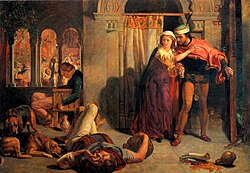
On a bitterly arctic night, an elderly beadsman says his prayers in the chapel of the ancestral home of Madeline'southward family, where a loud party has begun.[7] Madeline pines for the honey of Porphyro, sworn enemy to her kin. She has heard 'erstwhile dames full many times declare' that she may receive sugariness dreams of her lover if, on this nighttime, St. Agnes' Eve, she retires to bed following the proper rituals.
Later that night, Porphyro makes his style to the castle and braves entry, seeking out Angela, an elderly woman friendly to his family, and importuning her to lead him to Madeline's room at night, where he may but gaze upon her sleeping class. Angela is persuaded only with difficulty, and first obtains some food from the feast for them.[7]
Curtained in an ornate, carved closet in Madeline's room, Porphyro watches as Madeline makes fix for bed. He creeps along every bit she sleeps, to fix a banquet of rare delicacies. Madeline wakes and sees before her the same paradigm she has seen in her dream and, thinking Porphyro part of it, receives him into her bed. Waking in full and realising her mistake, she tells Porphyro she cannot hate him for his deception since her heart is and then much in his, but that if he goes now he leaves behind "A dove forlorn and lost / With ill unpruned wing".
Porphyro declares his love for Madeline and promises her a home with him over the southern moors. They flee from the castle, passing insensate, drunken revellers and rush into the nighttime. Angela's death is revealed in the poem's final stanza and the beadsman, "after thousand aves told, / For aye unsought for slept among his ashes cold".
[edit]
Written in the Gothic manner, the poem reflects "...many of the aforementioned concerns that Keats explores in his odes--imagination, dreaming and vision, and life as a mixture of opposites."[8] In it, Keats blends a medieval legend with a tale of star-crossed lovers, such Romeo and Juliet and the traditional French romance Floris and Blancheflour.
Alluded to past others [edit]
- Rudyard Kipling's short story "Wireless" (1902) has the narrator witnessing a recreation of the poem by a man in a trance who, by virtue of the similarities of his situation to that of Keats (he is a consumptive apothecary's assistant), becomes "tuned" to the poet.[9]
References [edit]
- ^ Sperry, Stuart M. (1993). "Romance as Wish Fulfillment: The Eve of St. Agnes", in Romantic Poetry: Recent Revisionary Criticism edited by Karl Kroeber and Gene W. Ruoff. New Brunswick NJ: Rutgers University Press. pp. 373–85. ISBN978-0813520100 . Retrieved 24 May 2017.
- ^ "The Eve of St. Agnes", Bookshop.org
- ^ a b Castelow, Ellen. "Eve of St Agnes", Historic UK
- ^ "John Keats in Chichester". The History Guide.
- ^ "Have a seat next to Keats". Chichester Observer.
- ^ "Manuscript of 'St Agnes Eve' by John Keats", British Library
- ^ a b Michie, Allen. "Verse Remembrance: John Keats, 'The Eve of St. Agnes' — Forever Immature at 200", The Arts Fuse, nine September 2020
- ^ Melani, Lilia. "The Eve of St. Agnes", Brooklyn College - CUNY, 19 Feb 2009
- ^ "Wireless". The Kipling Social club.
External links [edit]
- An omnibus collection of Keats' poetry at Standard Ebooks
- 'St. Agnes Eve', Text of 'St. Agnes' Eve' by Keats from Bartleby.
- The Eve of St. Agnes at Internet Archive (scanned books color illustrated). Notable editions:
- The Eve of St. Agnes (1900) calligraphy past Ralph Fletcher Seymour, "Introduction" by Edmund Gosse
- The Eve of St. Agnes (1885) illus. by Edmund H. Garrett
- The Theme of The Eve of St. Agnes in the Pre-Raphaelite Movement, An assay of the verse form at Victorianweb
-
 The Eve of St. Agnes public domain audiobook at LibriVox
Source: https://en.wikipedia.org/wiki/The_Eve_of_St._Agnes
Belum ada Komentar untuk "How Does the Eve of St Agnes Go Again Enlightenment Era"
Posting Komentar